Artifact
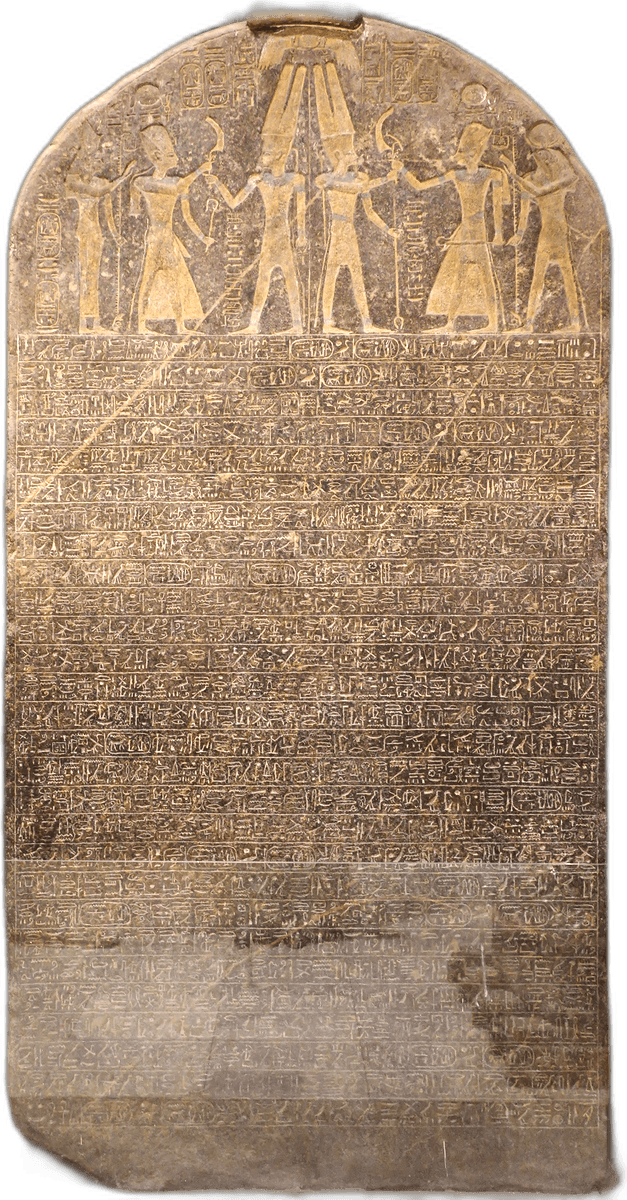
Merneptah Stele
c. 1208 BC
Contains the earliest extra-biblical mention of Israel, establishing that a people called Israel existed in Canaan by at least 1208 BC. This provides a crucial chronological anchor for dating the Israelite settlement and the events described in the books of Joshua and Judges.
About this artifact
Discovered in 1896 by Sir Flinders Petrie, the father of modern Egyptology, in the mortuary temple of Pharaoh Merneptah at Thebes (modern Luxor) in Egypt. The ten-foot-tall black granite stele, dating to approximately 1208 BC, is primarily a victory hymn celebrating Merneptah's military campaigns in Libya and Canaan. Near the end of the inscription appears the line 'Israel is laid waste; his seed is no more' — the earliest known reference to Israel in any ancient text outside the Bible. The Egyptian determinative sign used for 'Israel' identifies it as a people rather than a place, suggesting Israel had not yet established a fixed territorial state.
Inscribed in Egypt around 1208 BC, in the era of the Judges — its victory hymn carries the line 'Israel is laid waste,' the earliest mention of Israel as a people anywhere outside the Bible.